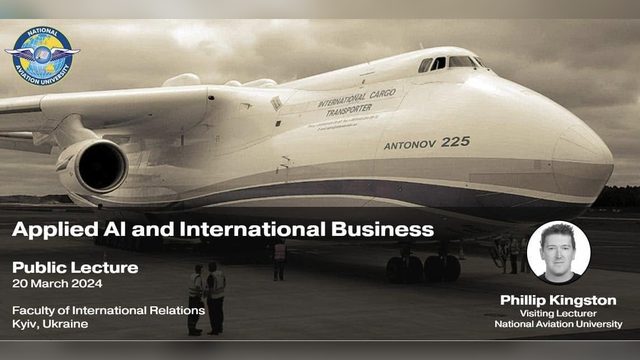

Phillip Kingston

ORCID: 0009-0005-2256-3079

Phillip Kingston is a Visiting Professor at State University Kyiv Aviation Institute, Kyiv, Ukraine and a Member of Technical Staff at AppliedAI in Abu Dhabi, United Arab Emirates.

Phillip Kingston's recent research advances AI-driven workflow automation in complex business environments and, more recently, extends into safety-critical autonomous control. His work addresses the end-to-end generation of complex workflows – from formalizing the intent behind a process to optimizing and rigorously evaluating its execution – with an emphasis on incorporating domain knowledge and multimodal data. A parallel line of work brings the same optimization-under-constraint thinking to physical systems, fusing physical chemistry with neural control to deliver autonomous life support in extreme environments, underpinned by formal guarantees on control behaviour. The following are the main technical areas of his contributions:

Workflow Automation and Optimization

Formalization of Workflow Intention and Business Artefacts

Multimodal AI and Attention-Based Processing

Graph-Based Knowledge Integration

Optimization Techniques for AI-Driven Workflows

Quantitative Workflow Evaluation

Safety-Critical Autonomous Control and Life Support

Overall, Phillip Kingston's research contributions center on bridging AI with operational business processes – formalizing the concept of a workflow intention, harnessing multimodal data through advanced neural architectures, injecting knowledge via graphs, and optimizing the results for real-world efficiency. His work provides a pathway to transform high-level process requirements into executable, optimized workflows that maintain compliance with domain knowledge and performance criteria. More recently, he has extended these ideas beyond digital workflows – developing quantitative, probabilistic frameworks for evaluating workflow quality and carrying the same optimization-under-constraint and formal-guarantee thinking into safety-critical autonomous control, where physics-grounded models and neural controllers cooperate to deliver reliable life support in extreme environments.

Papers:

Connect:

Gravatar, Google Scholar, Frontiers, arXiv, Semantic Scholar, GitHub Profile, HuggingFace, LinkedIn, X / Twitter, GitHub.